Dinner Meeting held November 9, 2026 at the The Susquehanna Club
On October 27th, FPA VP Dr. Alan Stolberg gave a wide-ranging presentation about Foreign Policy and the Midterm Elections. He started his presentation with a disclaimer regarding the non-partisan status of the organization.
Dr. Stolberg began his discussion with a few historical examples of how foreign policy perspectives changed election expectations like after the 2003 invasion of Iraq.
He then provided research about how foreign policy topics in different regions of the world might affect the mid-term election behavior in the US.
The first region he discussed was Iran and the way the War in Iran had cost $40 billion and depleted some of the US missile systems. He pointed out that the public was evenly split on the war.
The next topic he addressed was the RussianUkraine War. He pointed out that the US spent $192 billion for the war effort and sent 190 Patriot missiles to the Ukraine. The attacks on energy infrastructure have pushed up the price of diesel and affected people’s attitudes towards NATO.
Next Dr. Stolberg discussed the Israel-Palestine Gaza War that has become a political topic in elections with people polarized about the War of Choice.
The next topic addressed was China focused on agricultural trade, which has been affected by the tariff war. He pointed out that friction by farmers over the lack of soybean purchases has been addressed recently so there may not be a large effect on the election.
The last two countries Dr. Stolberg addressed were Cuba and Canada. Cuban sanctions were discussed as well as the lack of immigration opportunities from Cuba as being potential voter concerns. Canada as the largest foreign market for the US affects several states like North Dakota, Michigan, and Ohio, who have been hit hardest by the tariff war. Most Americans oppose Canadian sanctions. The effect of tariffs on inflation was also discussed.
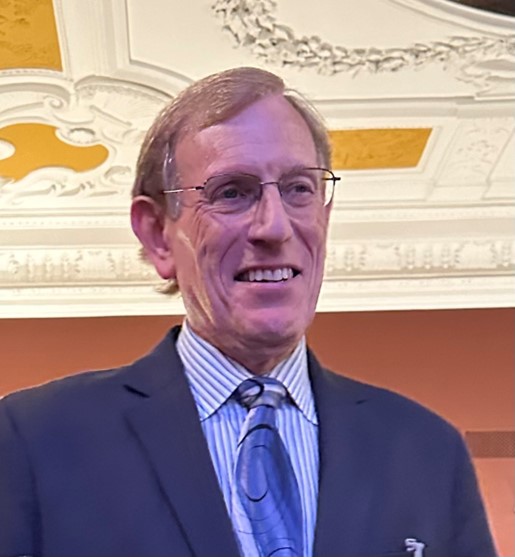
Alan G. Stolberg is an adjunct policy analyst. He focuses on defense education, security, cooperation, and associated lessons learned from the Russia-Ukraine War. Previously, he was coordinator of the Defense Education Enhancement Program at RAND, where he planned and orchestrated the execution of DoD support for foreign professional military education (PME) institutions on a global basis. The focus was on war colleges, staff colleges, military academies, junior officer courses, and non-commissioned officer academies. He was also a professor of policy analysis at the RAND School of Public Policy.
He also served on the resident faculty of the U.S. Army War College as Associate Professor of National Security Studies and, for three years, as the Henry L. Stimson Chair of Military Studies. He served on active duty in the Army for thirty years, retiring as a Colonel. His last three years of active service were spent as the War College’s Director of European Studies. Focus areas were policy and strategy formulation, European and Eurasian studies, the interagency, and security cooperation.